Fabric IQ Ontology Layer: One Definition to Rule Your Data (Finally)
Part 1 of 4: The Strategic Overview
You know the moment. You’re three hours deep into a meeting that could’ve been an email, and someone says: “Okay but… what do we actually mean by ‘Active Customer’?”
The room goes quiet.
The data engineer looks like they’re doing mental math to calculate how fast they can fake a network outage.
The business analyst pulls up a spreadsheet last touched during the pre-pandemic era.
And someone drops, “Well the old definition…” like we’re discussing ancient scripture. (Or we’ve always done it this way is fun too)
Welcome to semantic chaos; the thing Microsoft Fabric IQ is trying to fix. And at the center of that promise is the Ontology Layer: a unified semantic framework meant to end the decades-long war over what your data means.
Important note: Fabric IQ can’t force your org to agree on definitions. It can only make disagreement painfully obvious—and harder to ignore.
This four-part series is the practical guide to making it work:
Part 1 (this post): Strategic overview—what the Ontology Layer is and why it matters
Part 2: Hands-on entity + relationship modeling in Fabric IQ
Part 3: Migrating your existing Power BI semantic models
Part 4: Governance configuration—permissions, workflows, and version control
Let’s start with the foundation.
What the Ontology Layer Actually Is
The Fabric IQ Ontology Layer is a centralized, governed semantic model that defines your core business entities, their attributes, relationships, and hierarchies. It sits above your physical data in OneLake (Fabric’s unified data lake) and gives both humans and Foundry IQ agents the context to interpret what the data represents.
Think of it like this:
Physical reality:
TBL_CUST_2024_v3_FINAL_FINALcontains customer-ish rows. Probably.Semantic reality: “Customer” is an entity with an active contractual relationship and at least one transaction in the trailing 12 months (or whatever your org finally agrees on after 17 meetings).
The ontology is the layer that turns “here’s a table” into “here’s what the business actually means.”
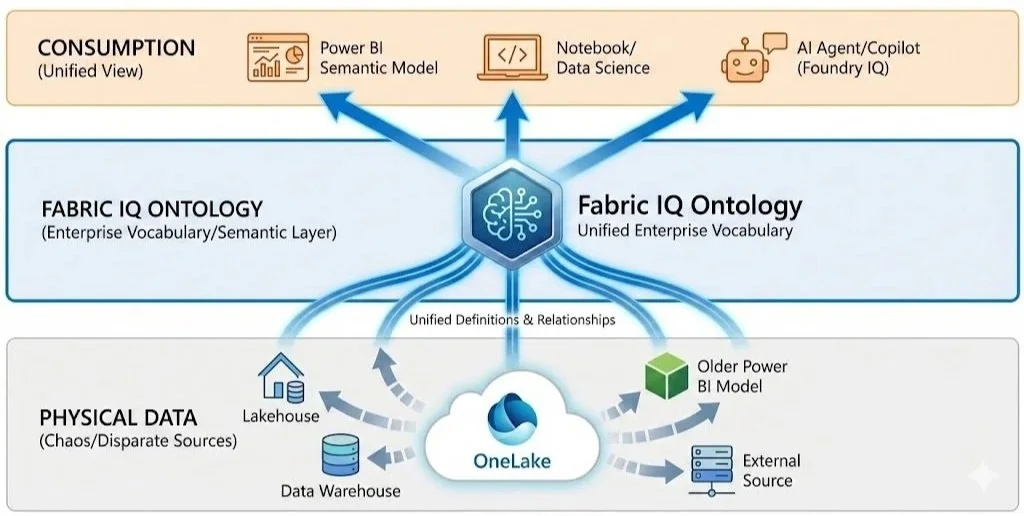
The Shift from Scattered to Consolidated
If you’ve been in the Microsoft BI ecosystem for more than five minutes, you have semantic models. Lots of them. Every Power BI dataset has its own definitions, relationships, and subtle interpretation of what “Revenue” means.
That approach works fine right up until:
Execs compare two reports and get two “truths”
You try to do cross-functional analytics and everything turns into a reconciliation project
You introduce AI agents who need definitions to answer questions without making stuff up
Fabric IQ’s pitch is: stop letting semantics live in 47 different Power BI datasets and consolidate definitions into one governed layer.
One definition of Customer.
One definition of Revenue.
One semantic source of truth… that you can actually enforce.
What the Ontology Contains
At a practical level, your ontology defines:
| Component | What It Captures | Example |
|---|---|---|
| Entities | Core business objects | Customer, Order, Product, Employee |
| Attributes | Properties of entities | Customer.Segment, Order.Status, Product.SKU |
| Relationships | How entities connect | Customer places Order, Order contains Product |
| Hierarchies | Roll-up structures | Region-->Country=-->State-->City |
| Business Descriptions | Human-readable definitions | "Active Customer: entity with transaction in trailing 12 months" |
If you’re thinking “so… a common data model?” yes. But the difference is it’s not just documented—it’s operationalized.
Why This Matters Now: The AI Problem
Could you have built a common data model ten years ago? Absolutely. Many of us tried. Some of us still have the scars.
So why is this different now?
Because agents raise the stakes.
When someone asks an AI agent: “Show me sales by region,” the agent needs to know:
What counts as “sales” (gross? net? booked? recognized?)
What counts as “region” (billing? shipping? territory?)
How those entities relate
If the ontology is messy—or missing—the agent fills in gaps. Sometimes it gets lucky. Sometimes it confidently hands you the wrong answer with the charisma of someone who definitely did not check lineage. (I think we’ve all made that mistake, guessing an answer vs saying I don’t know)
People call that “hallucination.”
In real life it’s: a governance failure with a business impact.
The rules are brutally simple:
Clean ontology + AI agent = trustworthy answers
Messy ontology + AI agent = wrong answers at scale
Fabric IQ ontology isn’t just data architecture anymore. It’s the difference between “AI that helps” and “AI that causes an incident postmortem.”
The Two Pillars: Modeling and Governance
If you want Fabric IQ to succeed, two things have to be true:
Pillar 1: The Modeling Effort
The technical work: entities, relationships, hierarchies, and resolving conflicts between existing definitions.
Key questions:
What are your core business entities?
How do they relate?
What Power BI semantic models already exist?
What do you do when definitions disagree? (Spoiler: they will.)
We’ll cover hands-on modeling in Part 2 and semantic model migration in Part 3.
Pillar 2: The Governance Framework
The human work: ownership, approvals, workflows, and preventing the ontology from drifting back into chaos.
Key questions:
Who’s the authority on “Customer”—IT or the business? (This can be a battle in a lot of orgs)
What’s the change workflow?
How do you prevent definition drift?
What happens when departments disagree? (Also: they will.)
We’ll cover configuration in Part 4, but here’s the uncomfortable truth: governance is where most ontology initiatives go to die. Not because the tech fails. Because consensus is a renewable resource; that most orgs refuse to fund.
The Ownership Question: Solve This Before You Build Anything
Before you model a single entity, decide: who gets to define reality?
Here are the three patterns you’ll see:
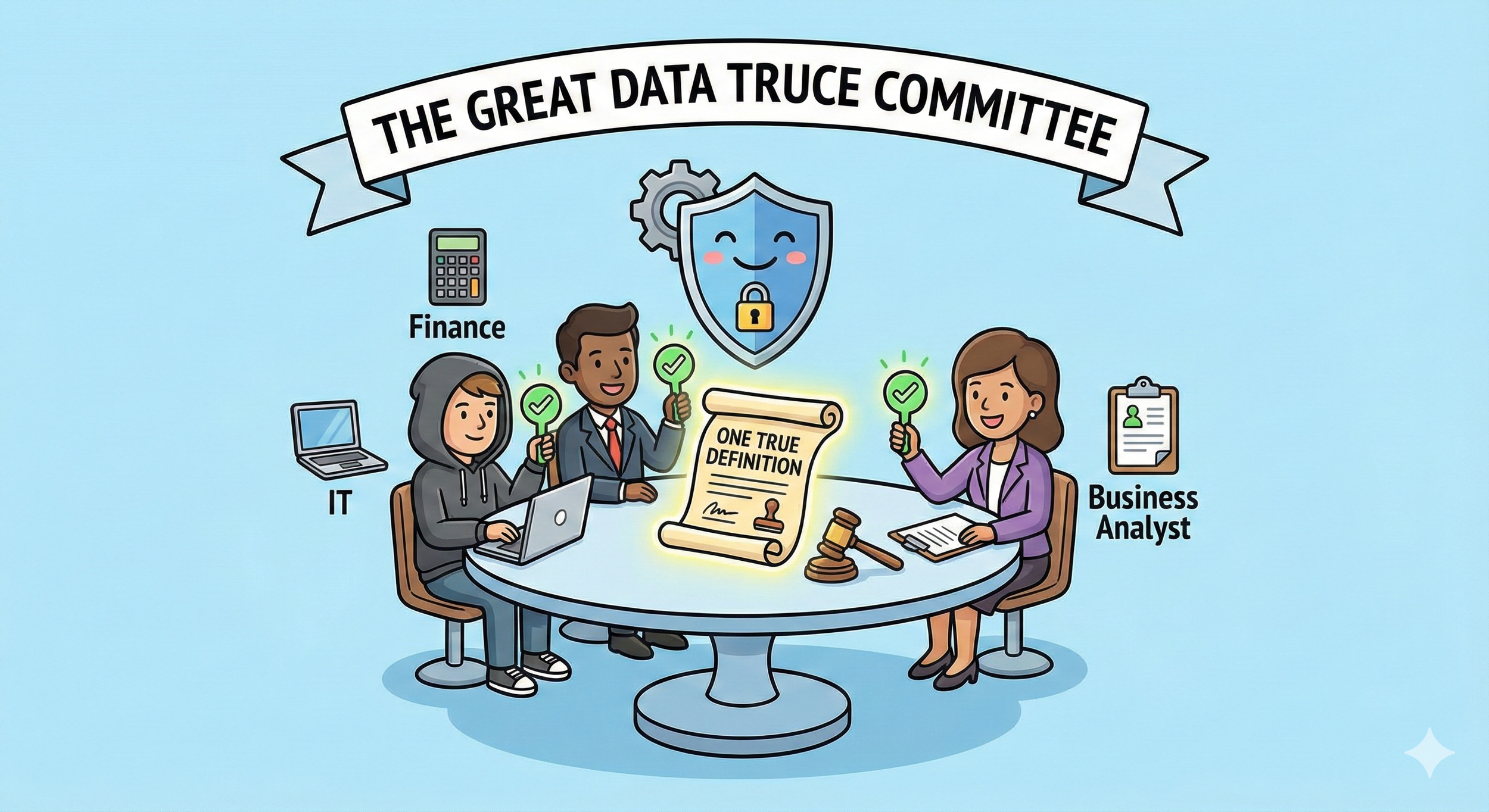
1) IT-as-Custodian
Data architecture owns the ontology; business gives input.
Works when: your data team is trusted and connected to the business.
Fails when: IT becomes a bottleneck or drifts away from real-world meaning.
2) Business-as-Owner
Finance owns finance definitions, Sales owns customer definitions, etc.
Works when: you have strong domain ownership and actual governance discipline.
Fails when: domains can’t align on cross-functional entities (aka the ones that matter).
3) Joint Steering Group
Cross-functional governance board decides definitions. Domains propose; group approves.
Works when: you have executive sponsorship and decision-making discipline.
Fails when: it becomes a committee that meets forever and decides nothing (RIP, many initiatives).
My honest take: Joint Steering is the only model that scales and it’s the most expensive operationally. If your org won’t support it, no tool is going to “fix semantics for you.”
A Brief History of Failed Semantic Models
If this is your organization's first attempt at a common data model, congratulations on your optimism. For the rest of us, here's why previous attempts failed—and why Fabric IQ is different:
Previous Failure Modes:
The Excel Era: A spreadsheet of "official" definitions, emailed around, forked seventeen times, now archaeologically layered across SharePoint.
The Data Dictionary PDF: A 400-page document from 2018 that nobody reads and nobody updates.
The Rogue Semantic Model: One team's really good Power BI dataset became de facto standard, except the owner left and nobody has admin rights.
The Committee-Designed Camel:18 months to define "Customer" so precisely that the definition is technically accurate and practically useless.
What's Different About Fabric IQ:
Infrastructure for enforcement: Definitions aren't just “documented” they're used by reports and agents.
Version control built in: Changes are tracked, reversible, and auditable.
Lineage visibility: You can see what breaks when a definition changes.
AI pressure: Getting this wrong now hurts faster and louder.
The tooling finally supports semantic governance. Now the question is whether your org can handle the responsibility. Technology still can’t fix organizational issues, unfortunately (It gets expensive when you try!)
The Path Forward: Start Small, Govern Hard
Here's the practical starting point:
Identify 3-5 core entities that are genuinely cross-functional: Customer, Product, Order, Employee, Location are common starting points
Establish your ownership model before you open the Fabric IQ interface
Inventory existing semantic models that define these entities (Part 3 covers this in detail)
Get executive sponsorship for the governance body—in writing, with time commitment
Then model those five entities, get the governance working, and prove your organization can maintain consensus before expanding. Because if you can’t govern five entities, you definitely can’t govern fifty.
What's Next
In Part 2, we'll get hands-on: creating entities, modeling relationships, configuring hierarchies, and navigating the Fabric IQ interface.
In Part 3, migrating Power BI semantic models. What to preserve vs refactor, and how not to break production.
In Part 4, we'll configure governance: permissions, approval workflows, version control, and integration with Microsoft Purview.
Your data governance committee has spent years debating definitions in meetings that felt pointless. Fabric IQ gives those definitions operational teeth.
Time to see if the committee is ready.
Next in Series: Look out for Part 2: Hands-On Entity and Relationship Modeling in Fabric IQ