

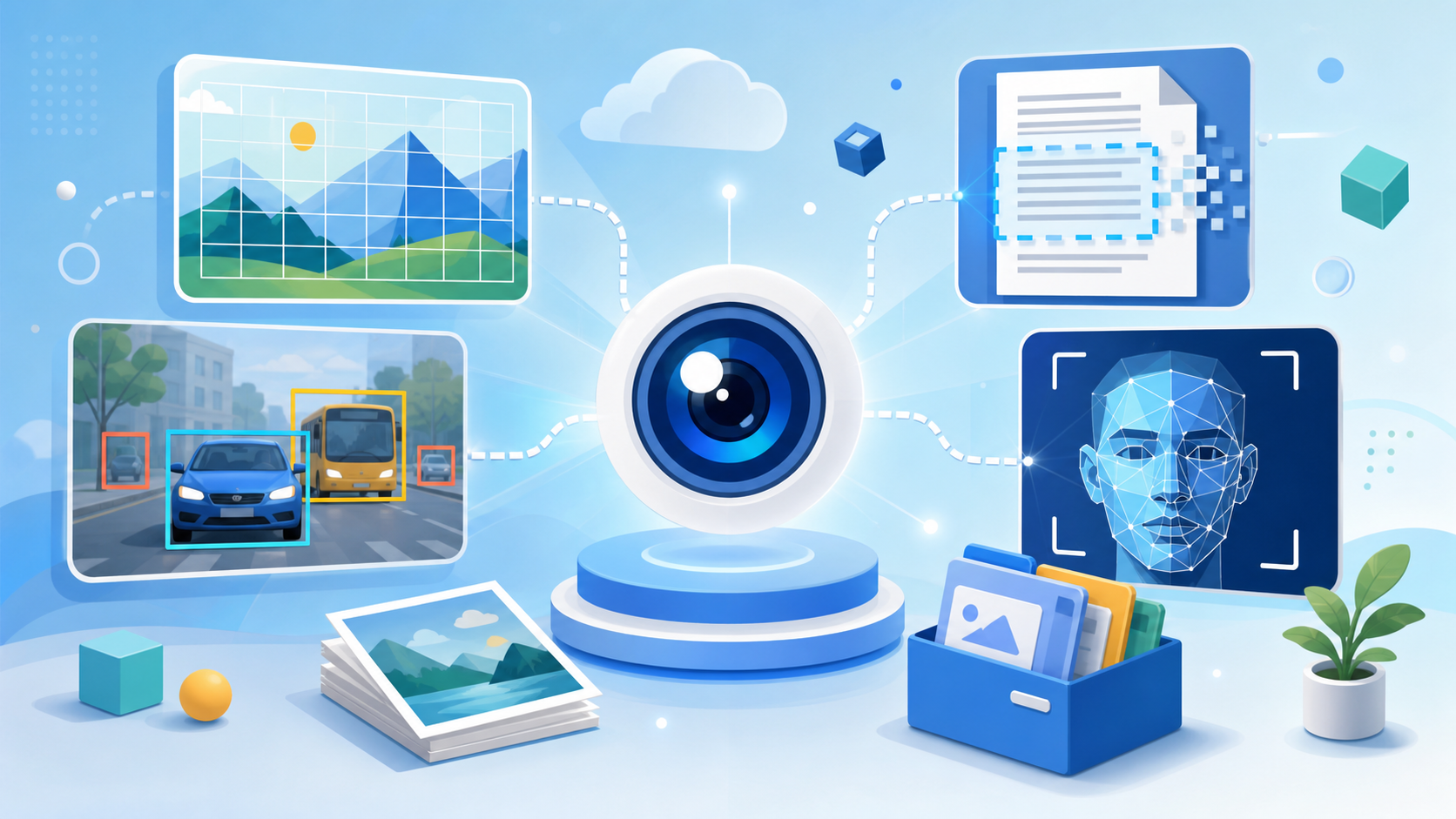
For the AI-901 exam, visual AI comes down to keeping track of which way the information flows. You are either feeding in an image to get data back, or feeding in text to get a picture back.
Image in, information out: Computer vision. The system reads pixels from an existing file or video feed.
Text prompt in, image out: Image generation. The system creates a brand-new visual from words.
What the Exam Expects You to Know
This article covers the Microsoft AI-901 objective: Identify features and capabilities of computer vision and image-generation models.
You should be able to:
Recognize computer vision tasks used for analyzing images.
Recognize image-generation models used for creating images.
Understand that multimodal models can interpret images alongside text in a conversational context.
Expect scenario-based questions: the exam may describe a photo, scanned document, live camera feed, or a request to design an asset, and then ask which visual AI capability fits the requirement.
Two Directions: Analyze Versus Generate
The cleanest mental model is the direction of the arrow.
| Direction | Input | Output | Capability |
|---|---|---|---|
| Analyze | An image | A description, label, location, or extracted text. | Computer vision |
| Generate | A text prompt | A brand new image. | Image-generation model |
If a scenario hands the system a picture and asks what is in it, that is analysis. If it hands the system a description and asks for a picture, that is generation.
Computer Vision (Reading Existing Images)
When a system looks at a photo, a document scan, or a live camera feed to tell you what is going on, that falls under computer vision. On the test, Microsoft usually checks whether you can tell four specific tasks apart:
| The task is... | If the system needs to... |
|---|---|
| Image classification | Decide what category an entire image belongs to |
| Object detection | Find specific items and map exactly where they are |
| Optical character recognition (OCR) | Read printed or handwritten text from an image |
| Image analysis | Describe content, tags, or features in an image |
Quick examples:
Image classification: A recycling app labels a photo as paper, plastic, glass, or metal.
Object detection: A traffic system counts cars, buses, and bicycles in a video frame and returns the bounding box coordinates for each.
OCR: An app reads a serial number from a photo of a hardware label.
Image analysis: A system generates descriptive tags and a caption for an uploaded photo.
Exam Scenario: A factory camera checks finished parts on an assembly line and marks each one as either "pass" or "fail." Because the system assigns a single label to the entire photo, that is image classification.
Multimodal Models (Working with Images in Chat)
Multimodal models let you hand an image to a chatbot alongside a text question. You might upload a picture of a broken pipe and ask what kind of fitting you need to buy.
Exam Catch: Even though you are having a conversation, the model is still interpreting a photo you provided. That keeps it on the analysis side of the house, alongside computer vision.
Image Generation (Creating New Visuals)
Image generation works the other way around. You type out a description, and the model creates a brand-new visual that did not exist before.
Common uses:
Generating concept art or product mockups from a description.
Creating marketing visuals or unique illustrations.
Producing variations of a visual idea for brainstorming.
Exam Scenario: A marketing team needs a picture of "a quiet bookstore with large sunlit windows" for a campaign brochure. Because you start with words and end up with a new image, this uses an image-generation model.
Exam Tip: Follow the data arrow.
Image in, information out = Computer vision.
Needs a broad category? Classification.
Needs items and locations? Object detection.
Needs text read from the image? OCR.
Text prompt in, new image out = Image-generation model.
Interpreting an uploaded image inside a chat = Multimodal model.
Common Trap: Do not confuse analyzing an image with generating one. Describing or reading a photo is computer vision. Creating a brand-new image from words is image generation. The exam will pair these to test if you track the direction.
Also, do not assume every computer vision task is classification. If the scenario specifically requires finding the location of objects, that is object detection.
Quick Knowledge Check
A team wants a system to create a new product mockup from the description "a red sneaker on a white background." Which capability fits?
A warehouse camera must find every forklift in an image and return each location's coordinates. Which computer vision task fits?
A user uploads a photo of an error screen and asks a chat assistant what it means. Which kind of model interprets the image?
An app reads the printed model number from a photo of a device label. Which computer vision task fits?
Answers
An image-generation model. The system creates a new image from a text prompt.
Object detection. The system finds items and returns their specific locations.
A multimodal model. It can interpret the image alongside the text prompt in a conversational flow.
OCR (Optical Character Recognition). The system reads text out of an image.
Microsoft References For Further Study
Cross-reference this guide with the official Microsoft Learn documentation to familiarize yourself with their exact terminology:
