Crushing Technical Debt with AI: A Deep Dive into AWS Transform Custom
Technical debt isn't a metaphor anymore. It's a line item. It's the 30% of engineering capacity that organizations routinely burn maintaining systems they wish they could replace. It's the migration project that started in 2019 and still limps along. It's the SQL Server instance nobody dares touch because the one person who understood it left three jobs ago.
At re:Invent 2025, AWS made its position clear—literally staging a live demolition of a decommissioned server rack at the festival grounds in Las Vegas, a to kick off the Transform announcements. Theatrical? Absolutely. But the underlying message is serious: agentic AI is ready to take on the gnarliest modernization work enterprises have been deferring for years.

What's New in AWS Transform
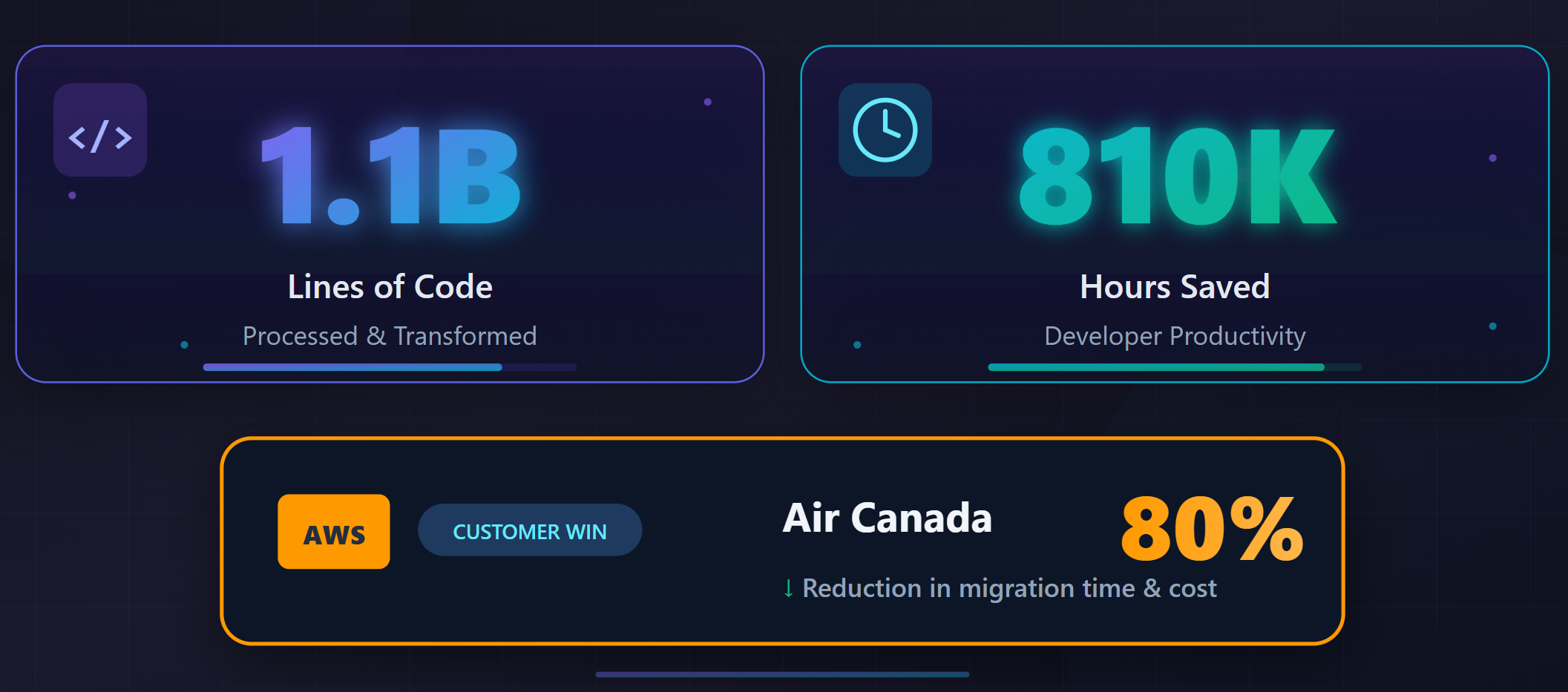
AWS Transform (the engine powering the Amazon Q Developer Agent for Code Transformation) isn't new—it launched earlier this year and has already processed over 1.1 billion lines of code across customer deployments, reportedly saving more than 810,000 hours of manual effort. What's new is the scope and flexibility.
The re:Invent announcements expanded Transform in three major directions. First, AWS introduced Transform Custom, which allows organizations to define their own transformation logic for any code, framework, or even company-specific programming languages. Second, the service now handles full-stack Windows modernization, addressing application code, databases, UI frameworks, and deployment layers in a coordinated workflow. Third, Transform added enterprise VMware migration capabilities and enhanced mainframe modernization with what AWS calls "reimagine" features—AI-driven architecture redesign based on business logic extraction.
The messaging shift matters here. This isn't AWS pitching experimental AI features to early adopters. The positioning is squarely enterprise-focused: reduce the 30% tax that modernization work places on engineering teams, free up capacity for innovation, and do it at a pace that makes multi-year migration timelines look quaint.
Custom Transformation Logic: Why This Is the Big Deal
Pre-built transformations are helpful. Java 8 to 17 upgrades, Python runtime modernization, Lambda function updates, AWS SDK migrations—these patterns cover ground. But enterprises don't run on patterns alone. They run on fifteen years of accumulated frameworks, homegrown libraries, internal coding conventions, and that one abstraction layer someone built in 2012 that everything still depends on.
Transform Custom addresses this directly. Engineers can define transformation rules using natural language, reference documentation, or code samples. The system learns from these definitions and applies them autonomously across codebases, parallelizing the work across an entire organization.
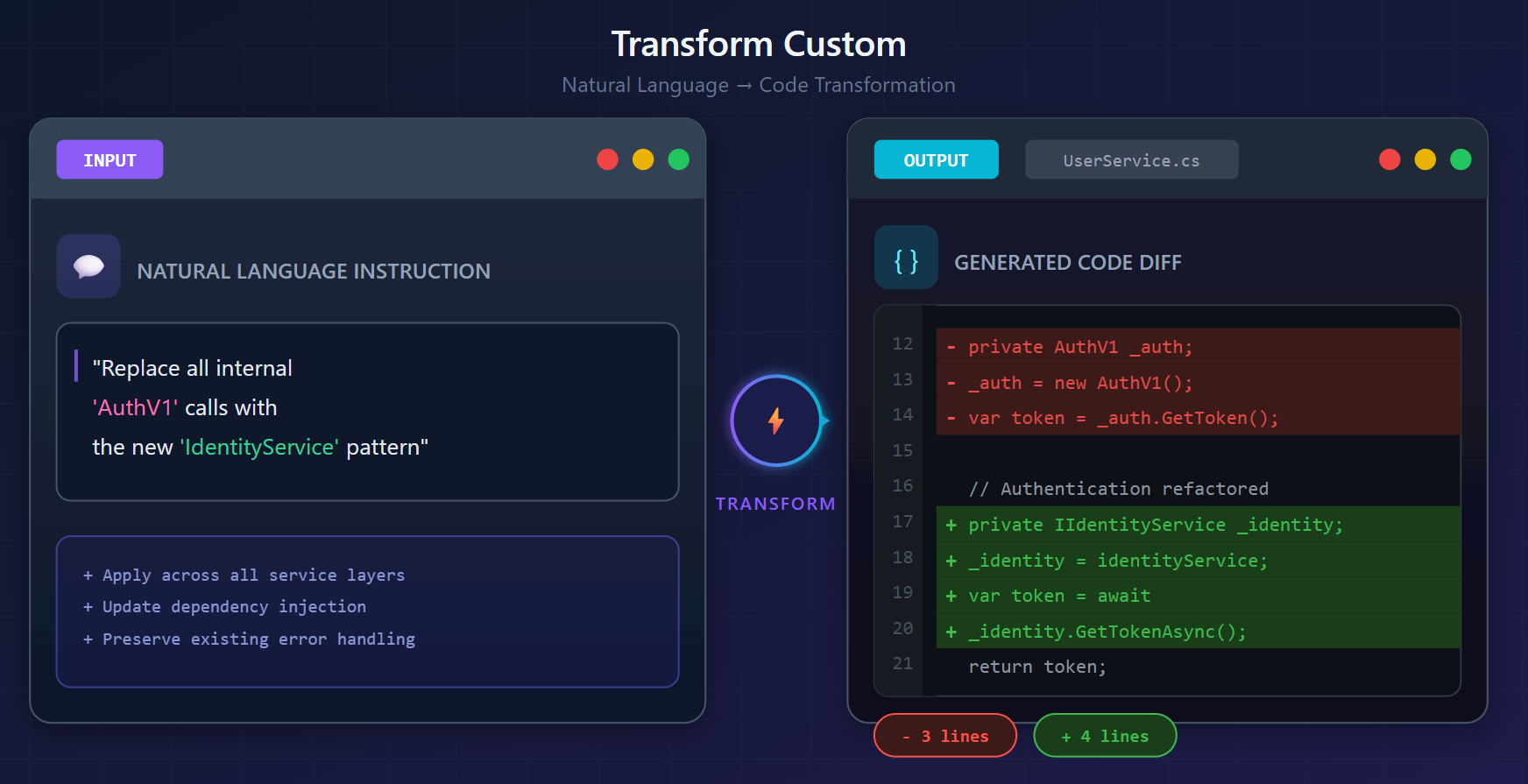
The implementation details matter for practical adoption. Transform Custom provides both CLI and web interfaces, meaning it can integrate into existing CI/CD pipelines. You define what you want the output to look like, the agents execute consistently and repeatably, and you get detailed reports after each transformation run. Within an organization, the agent learns from developer feedback and execution results, improving accuracy over time. For teams wary of "black box" AI, this feedback loop is critical—it ensures the agent adapts to your specific governance standards rather than forcing generic AWS patterns onto your codebase.
This puts control back where it belongs—with the engineering team—while still leveraging AI for the tedious execution work. You're not locked into whatever transformations AWS thought to pre-build. You're defining your own modernization playbook and having AI execute it at scale.
QAD, which provides ERP solutions for manufacturers, reported that modernizations that previously took two weeks now complete in three days. Air Canada modernized thousands of Lambda functions within days, achieving an 80% reduction in expected time and cost compared to manual migration.
Complex Database Modernization Scenarios
Database migrations are where modernization projects go to die. Schema conversion challenges, stored procedure rewrites, application-level changes to ORMs and data access layers—the complexity compounds quickly.
AWS Transform now handles SQL Server to Amazon Aurora PostgreSQL migrations as part of the full-stack Windows modernization capability. The agent connects to SQL Server databases running on EC2 or RDS, discovers schemas and stored procedures, performs dependency analysis, and generates a comprehensive modernization assessment. It converts SQL Server schemas to PostgreSQL-compatible formats, runs AI-led remediation loops to resolve conversion issues automatically, and ports stored procedures to work with Aurora PostgreSQL.
Transform analyzes both database and application code together, creating waves of applications and databases that can be transformed based on dependency relationships. For .NET applications, it updates database connections in source code and modifies ORM code in Entity Framework and ADO.NET to be compatible with Aurora PostgreSQL—in a unified workflow.
Human supervision remains part of the workflow. You review modernization plans, approve transformation steps, and validate results. But the grunt work—the thousands of small changes across hundreds of files that make database migrations soul-crushing—that's what the agents handle. This shifts the engineering role from manual refactoring to high-level verification, ensuring teams retain control over the architecture without drowning in the syntax.
Full-Stack Windows Modernization
Windows workloads represent some of the most stubborn technical debt in enterprise environments. A .NET Framework application tied to SQL Server, running on Windows Server with IIS dependencies and legacy UI frameworks isn't just one migration—it's five or six interlocking problems.
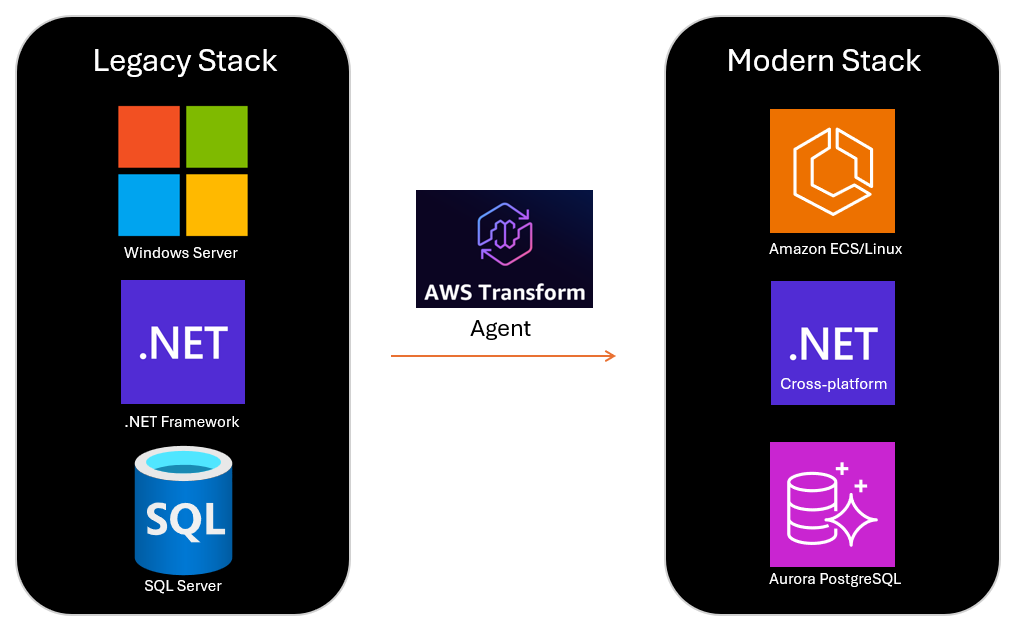
AWS Transform for full-stack Windows modernization treats the entire stack as a coordinated unit. The agent scans SQL Server databases and .NET application code from source repositories, creates customized modernization plans, transforms .NET Framework applications to cross-platform .NET, migrates SQL Server to Aurora PostgreSQL, updates database access code, and deploys the transformed applications to containers on Amazon ECS or EC2 Linux.
AWS claims this accelerates full-stack Windows modernization by up to five times, while reducing operating costs by up to 70%—primarily from eliminating Windows Server and SQL Server licensing.
The wave plan generated by Transform covers schema conversion, data migration, application code transformation, and deployment. The agent provides comprehensive transformation summaries, including modified files, test outcomes, and suggested fixes for anything that didn't convert cleanly.
For organizations with dozens or hundreds of Windows workloads, this changes the economics of modernization entirely.
What This Changes for Engineering Teams
Let's be direct about what AI-powered modernization actually fixes.
It eliminates the most tedious, error-prone refactoring work. Updating thousands of API calls across a codebase, converting stored procedures one at a time, manually adjusting connection strings—this is exactly the kind of work that causes developers to update their resumes. AI agents handle it without complaining, without getting bored, and without introducing the subtle bugs that come from human attention fatigue.
It compresses modernization timelines dramatically. What previously required multi-year programs can potentially be accomplished in months. The parallelization aspect is key—agents work across an entire organization's codebase simultaneously.
It reduces the risk profile of large-scale transformations. Consistent, repeatable transformations produce more predictable results than dozens of engineers making similar-but-not-identical changes over extended periods.
Most importantly, it frees engineering teams for work that actually matters. Building new capabilities, improving architecture, solving customer problems—the work that drew people to engineering in the first place.
The Bigger Picture
AWS Transform Custom represents a meaningful shift in how enterprises can approach technical debt. Not through heroic multi-year efforts staffed by armies of contractors, but through AI-assisted modernization that executes systematically and learns from organizational context.

AWS is betting heavily on this approach. They've brought in partners like Accenture, Capgemini, and Pegasystems to build specialized agents for industries like financial services and healthcare. They're positioning Transform as a comprehensive IT transformation workbench rather than a point solution.
For engineering teams and their leadership, the takeaway is straightforward: the calculus on modernization projects just changed. That Java 8 monolith, those SQL Server databases, those Windows workloads you've been tolerating—the case for finally addressing them got significantly stronger.
Technical debt remains debt. But the cost of paying it down just dropped considerably.